Meet the winemakers: Udo and Hacer from Gelveri Winery

Updated: Jul 7
In the historic village of Güzelyurt, south of Cappadocia, a lunch table becomes a gateway into one of Anatolia's most fascinating wine stories. Here, ancient grape varieties, küp winemaking, and a passion for preserving local traditions come together in a truly memorable experience.

On a day when we left Cappadocia’s fairy chimney valleys with our guests from Massachusetts, Kate and Douglas, and set off toward Ihlara, we walked under the shade of trees along the Melendiz River, discovering plenty of rock-cut churches along the way. From here, our route took us to Güzelyurt, formerly known as Gelveri or Kalvari. Until 1924, Güzelyurt was an important settlement with a majority Christian Orthodox population. Before reaching our final destination, we visited the High Church (Analipsis) and St. George’s Church.
And then the moment we had been eagerly awaiting arrived… It wasn’t difficult to convince Kate and Douglas to join this activity—they’re already a couple who enjoy wine. In their home country, they’ve toured many vineyards and wineries in Oregon, California, and France. My proposal to them was: Would you like to try wine made from an endemic Anatolian grape you’ve never heard of before, aged in an ancient küp? Which is basically a clay vessel made from terracotta, widely referred as amphora.

There’s only one place in Türkiye where such an experience is possible: Gelveri Winery (Gelveri Manifaktur). Its owner, Udo Hirsch, greeted us at the gates of the “Taş Mahal,” which houses both his winery and his home. I explained to our guests that Udo isn’t particularly fond of the tourism business or tourist groups, but together with his partner Hacer, he enjoys hosting guests at their long table, serving the kind of lunch they eat every day, paired with wine tastings.
Udo spent many years working for WWF and other international organizations, traveling the world and developing wildlife conservation projects. His path crossed with Türkiye in 1969 for this reason. He’s a true intellectual who approaches every project with passion and dedication. After arriving in Türkiye, he became fascinated by Anatolian kilims and is now a recognized authority who has made significant contributions to the field. I still remember my surprise when he explained the connection he saw between motifs found in ancient Anatolian mounds and those in kilims.
While working on projects in Armenia and Georgia, Udo came to Güzelyurt. During his trips back and forth, he restored the Taş Mahal with his own hands. “After six years and 52 truckloads of excavation, it was finally finished—and I’ve been here for 14 years,” he says. Although from Mosel, one of Germany’s major wine regions, and an avid wine drinker, Udo has no formal viniculture training. However, while spending time in Armenia and Georgia, he learned about natural wine production in küps and decided to apply the concept in Güzelyurt. “You’ll find very few places as ideal for this work… We’re at 1,400 meters, on mineral-rich volcanic land, with extraordinary biodiversity.”

Udo makes just 6,000 bottles a year, all monocepage wines from seven local grape varieties. “That’s enough!” he says. Seventy percent of his wine is exported, with a loyal international following—including boutique wine bars and Michelin-starred restaurants—eagerly awaiting each vintage. His vines are 100–120 years old, producing grapes like Keten Gömlek, Hasan Dede, and İt Üzümü. When Douglas asked if the names meant anything, Udo laughed: “They’re all local names given by villagers. Even though we were the first to make wine from them, we didn’t want to change the names. For example, İt Üzümü (‘dog grape’) ripens late, when no one visits the vineyard anymore—except the dogs, who come to eat the grapes.”
Anatolia is a treasure trove of endemic grapes—an estimated 1,400 varieties suitable for winemaking, and Udo believes it could be as many as 1,600. He is the only licensed producer in Türkiye making wine in küp without any chemical intervention, using only wild yeast. Also globally, he says there are small number of such producers.
His winery, with its rows of ancient küps, is truly unique. I shared with Kate and Douglas my memory of the Dionysus Festival, where I once tasted wine from three different küps made from the same grape and harvest—each with a distinct taste, color, and aroma.
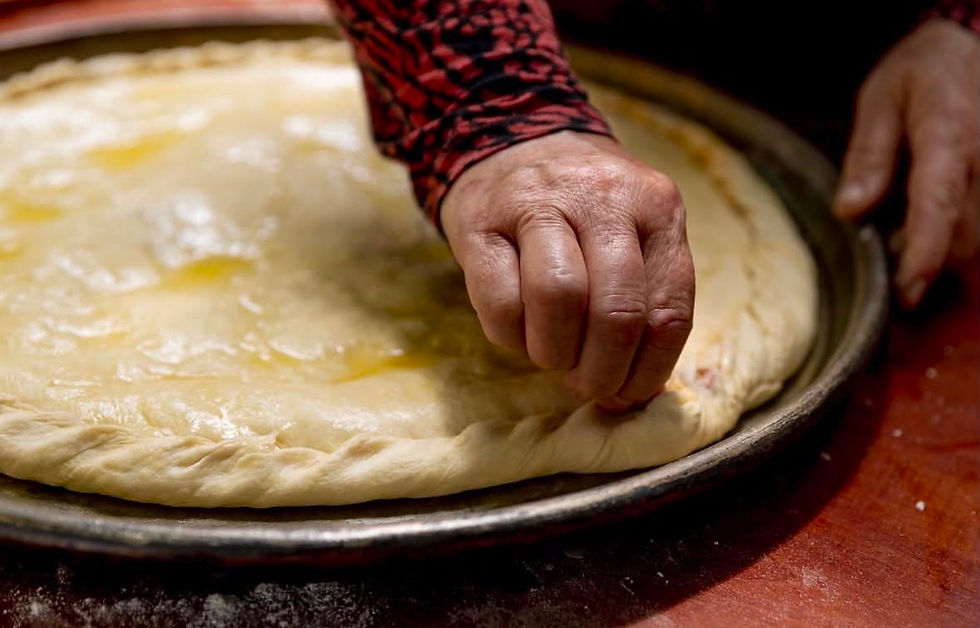
After learning about the küp, we moved upstairs to the Taş Mahal’s courtyard, where Hacer had prepared a menu of home-pickled olives, homemade cheese, and bread to accompany the wines, while Udo told us their stories. Everything tasted wonderful—a testament to the care and diligence Udo and Hacer put into their work. When everyone praised the cheese, Udo explained that they produce only 200 kg a year, using milk from goat grazing in the mountains at the end of August. “That timing matters—late August is when the animals are best fed, and the milk is at its peak quality. Otherwise, it wouldn’t taste this good.”