
A Cooking Class in Cappadocia: Culinary Traditions on One Plate

Updated: Jul 21
The best way to understand Cappadocia isn't only by exploring its valleys, but by gathering around a local kitchen table. In Mustafapaşa, generations of culinary traditions come together through recipes, stories, and shared meals.
After spending the morning wandering the valleys of Göreme, we head to Mustafapaşa for our cooking class. This lovely village, once known as Sinasos, actually carries three culinary traditions in its history: Turkish cuisine, the cooking of the Orthodox Christian Greek population who made up the majority here until the population exchange of 1924, and the cuisine brought by the Macedonian migrants who settled in the village after that same year.
Today in Mustafapaşa, we're guests at Aynur's home, because our travelers wanted the full experience: cooking alongside a local Cappadocian and then sitting down to enjoy the meal together. Aynur's own family arrived here in 1924 from a village in what is now northern Greece, and she picked up a bit of Macedonian from her grandparents along the way. She spent years working as a cook, so she knows Cappadocian cuisine inside and out. These days she's retired, splitting her time between her grandchildren and her garden, but whenever she can, she still loves teaching visitors who are curious about Turkish food how to cook it themselves.
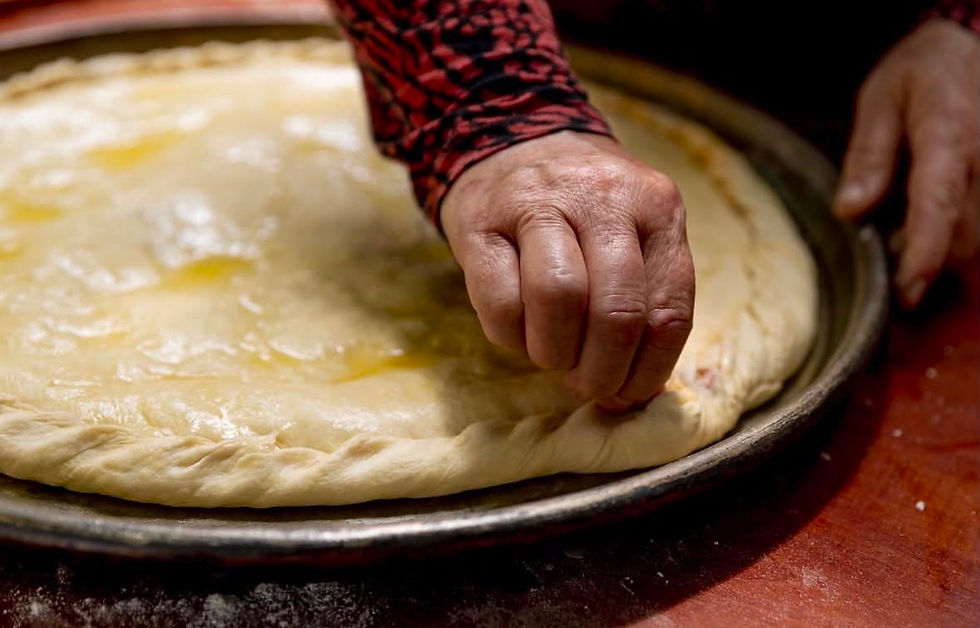
When we arrive, Aynur shows us the "muhacir böreği" she's just laid out on a tray (appears in the main picture). When you say "börek" in this part of the world, stretching from the Middle East across the old Ottoman geography all the way to the Balkans, people generally picture some kind of filling baked, fried, or open-fire cooked inside thin yufka pastry. But the version made in this village, called "muhacir böreği" (muhacir means "migrant" in Turkish), is a rare kind made with pickled cabbage. It's actually an original recipe passed down from Aynur's ancestors, who were Balkan migrants themselves. Aynur tells us she'll be cooking it over an open fire that evening, which is a genuinely laborious process, but a traditional and authentic method in every sense. After asking a few more questions, we get back to our own work, since börek isn't actually the subject of this lesson! To really do it justice, we'd need to design an advanced cooking class rather than a beginner one.
Our guests from New York are making three dishes today: Kayseri mantı (Turkish dumplings), karnıyarık (stuffed eggplant), and yaprak sarma (stuffed grape leaves). Aynur has a system: she preps each dish up to a certain point so the whole day doesn't disappear into the kitchen. After all, there's so much to see in Cappadocia, and the plan is to learn a bit of cooking, enjoy a good lunch, and then get back on the road. That said, she still walks guests through every step and explains exactly how each dish comes together, so once they're back home, they can recreate the same meals with a little practice.
First up is Kayseri mantı. This traditional dish starts with thinly rolled dough, which gets filled with a mix of ground meat, onion, and spices, then sealed into small parcels and boiled. It's served with garlicky yogurt on top and a butter and tomato paste sauce drizzled over it. It's easy to eat and surprisingly tricky to make. Our guests worked up a bit of a sweat just rolling out the dough, but the real challenge comes after: cutting that thin sheet into small squares, filling each one, and pinching them closed into little dumplings. Locally, this step is called "mantı sıkmak," or "squeezing the mantı."
Next, we move on to karnıyarık, a Turkish classic made almost everywhere in the country. Eggplants are split down the middle and stuffed with a mixture of ground meat, onion, tomato, and pepper, then baked in the oven or simmered on the stove. It's especially good served with rice pilaf and cacık (a yogurt and cucumber side), and Aynur had already prepared both for us in advance. The name karnıyarık actually means "split belly," which comes from slicing the eggplant open down the middle to make room for the filling. Our guests found this one a bit easier going than the mantı.
And then there's yaprak sarma. I might be a little biased, but I'd argue the best stuffed grape leaves in Türkiye come out of Cappadocia. Aynur has a real skill for picking exactly the right grape leaves, which she then cures in brine herself ahead of time. On cooking day, a filling made mostly of onion and spices gets spooned into each leaf and rolled up tight. One important detail: while rice is the more common filling elsewhere in Türkiye, here in Cappadocia bulgur is often used instead, though both versions are perfectly traditional. Eating those delicate little rolls is effortless, but rolling them that neatly takes real practice. After a lot of laughing and a few crooked attempts, we finally worked our way through the pile, and by then, we were more than ready to eat.
Once we'd polished off a few extra mezes Aynur had made just for us, along with her homemade walnut baklava, we headed back out to continue the tour. And of course, not before snapping a few photos to remember the day.

